
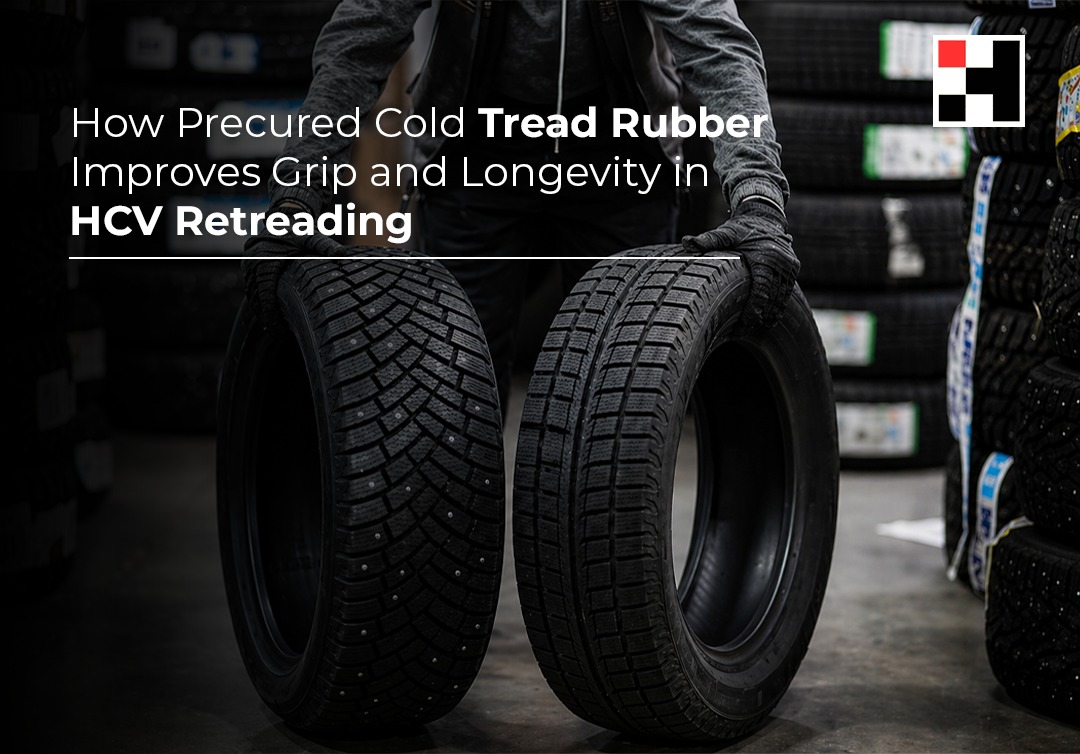
How Precured Cold Tread Rubber Improves Grip and Longevity in HCV Retreading
When it comes to running heavy commercial vehicles (HCVs), tyre performance is all about safety, fuel consumption, and costs. Retreading is a highly affordable solution to increase the life of HCVs, but the tread‑rubber technology used is highly important. Over the past few years, precured cold tread rubber has quickly gained popularity compared to conventional camelback hot tread rubber, particularly in vehicles looking for durability, wear resistance, and predictable tread life.
Meanwhile, the less-known components such as cushion gum rubber and rubber compound sheets are critical for ensuring retread tyre performance. If they are properly designed, they can help ensure a lasting bond is formed and the risk of premature failure, such as separation and uneven damage, is prevented. Here, we explore how precured cold tread rubber enhances performance and life span in HCV retreading and the importance of the compound.
What Is Precured Cold Tread Rubber?
The cold‑tread (or precured) process involves the tread rubber being completely cured and having a pre‑formed tread pattern before being supplied to the retreader. The pre‑formed strip is simply stuck to the polished casing of the tyre with cushion gum rubber, and the finished product is then compressed in heat and pressure.
This contrasts with the traditional “camelback” hot tread rubber process, where the tread strip is uncured, soft rubber that is applied to the cover and pressed down in a hot press; the tread pattern is formed during a process known as vulcanization. The precured cold tread rubber is produced under controlled conditions at the factory, ensuring consistent hardness, scratch durability, and grip, which in return leads to improved on-road performance.
Consistency in Grip: Precured Treads Feel Better
On India’s complex road conditions—from highways to rural roads—grip is essential for HCVs in brakes, steering, and load retention. The precured cold tread rubber design has some key benefits:
The tread design is accurately molded in the factory, so the contact surface properties are more uniform and water is easily circulated.
The tread is typically designed to have a certain surface hardness to balance grip and rolling resistance requirements, so the tyre grips without too much heat generation.
Combined with good cushion gum stickiness, the tread is less prone to twisting and flexing relative to the casing, which also helps with vibrations and steering stability.
On the ground, fleet operators report that HCVs with precured cold tread rubber retreads are more stable when braking and in the wet, which has a real safety and ride comfort benefit over the camelback‑style tyres.
Longevity: Less Stress, Better Mileage
Another major factor in the shift towards precured cold tread rubber is its effect on tyre mileage. A number of studies and reports indicate that tyres retreaded with the precured (cold) process can offer 50-75% more mileage than similar tyres retreaded using the traditional hot‑tread process. This improvement is due to a number of factors:
- Less harsh treatment of casing: Hot‑tread retreading exposes the whole casing to higher temperatures for longer, which can lead to rubber degradation and internal decomposition. Cold‑tread technology uses more controlled temperatures and heat, retaining the casing’s strength.
- Better‑quality tread compound: Precured treads are manufactured as sheets of rubber compound in a controlled mixing and curing environment so they can be formulated for optimal friction, tear, and heat‑aging resistance.
- Strong cushion-gum bond: The thin but strong cushion gum rubber layer between the casing and tread provides even stress distribution and prevents debonding, even with high load and shock impact forces.
Longer-lasting tyres for HCV fleets mean fewer tyre changes, less downtime, and reduced costs per kilometer, all of which boost bottom-line profitability.
Rubber Compound Sheets and Cushion Gum
The key ingredients to a good retreaded tyre are rubber compound sheets and cushion gum rubber. The buffed casing is first coated with cushion gum, and then the pre‑formed tread is applied. Cushion gum is shock‑absorbing and high‑tack glue.
High‑performance rubber compound sheets for retreading are designed to:
- Stick well to the casing and the strip.
- Show no cracks and tears under dynamic stress.
- Resist the high heat and stresses of HCV operation.
When a retreader uses these materials from a trusted supplier, a supplier with decades of experience and research working to optimize these compounds for consistency and durability, the retreaded tyre is less likely to suffer from early-life failures such as peeling, air voids, and random damage.
The importance of finding the right fit
Precured cold tread rubber offers advantages for HCV retreading: improved traction, durability, and consistency. But to get the most from these benefits, you require quality ingredients and technique. Whether you are considering traditional camelback hot tread rubber or cushion gum rubber for your retreading unit, it’s wise to partner with a manufacturer that has experience delivering HCV‑grade products and industrial‑scale processes.
To find out more about innovative rubber‑technology solutions for tyre retreading, see the website of Hitkari Rubber Industry, a leading Indian rubber‑compound manufacturer with years of experience in this sector.
Also Read: How Tread Rubber Is Revolutionizing Tire Performance and Safety.
Frequently Asked Questions
- What is the main difference between precured cold tread rubber and conventional camelback hot tread rubber?
Precured cold tread rubber is fully cured and patterned before application, applied with cushion gum, and then lightly cured to bond it to the casing. Conventional camelback hot tread rubber is left uncured, applied without a pre‑formed pattern, and fully cured in a hot press, which exposes the casing to higher temperatures.
- Does precured cold tread rubber work well for HCVs on Indian roads?
Yes. Precured treads are specifically engineered for abrasion resistance, controlled hardness, and consistent pattern depth, making them well‑suited for the mixed‑load, mixed‑road conditions typical of HCV operations. When used with strong cushion gum and quality rubber compound sheets, they offer reliable grip and longer mileage.
- How does cushion gum rubber improve retreaded tyre life?
Cushion gum rubber acts as a bonding and stress‑absorbing layer between the casing and the tread. It helps distribute mechanical loads evenly, reduces the risk of separation, and protects the interface from heat and vibration, which directly contributes to the longevity and safety of the retreaded tyre.
- Are rubber compound sheets used only in HCV retreading?
No. While they are widely used in HCV retreading, high‑grade rubber compound sheets also serve in many industrial applications such as flooring, sealing, and protective coverings, where flexibility, durability, and customization are essential.