
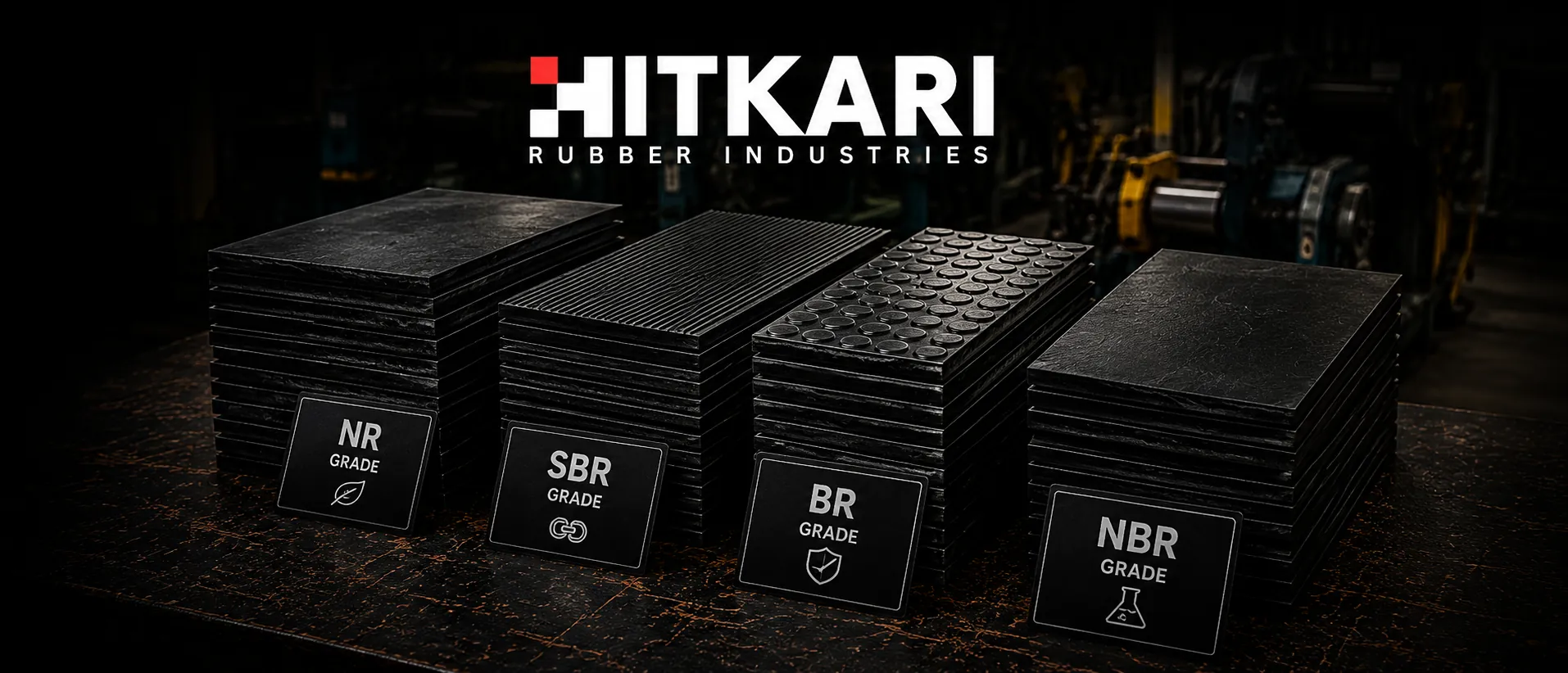
Rubber Compound Sheet Grades Explained — A Buyer Guide for Industrial Use
Walk into any industrial procurement office and ask about rubber compound sheets, and you will quickly run into the same challenge: dozens of grades, different hardness ratings, varying chemical resistances, and conflicting specifications between suppliers. Picking the wrong grade for an industrial application can mean premature failure, costly downtime, or even safety incidents. Understanding rubber compound sheet grades India suppliers offer is essential for engineers, procurement managers, and project planners who need to make informed sourcing decisions. This buyer guide breaks down the major rubber compound sheet grades, their key properties, and the industrial applications where each one performs best.
What Are Rubber Compound Sheets?
Rubber compound sheets are vulcanised rubber materials manufactured in standardised sheet form — typically in widths of 1 to 1.5 metres and thicknesses ranging from 1 millimetre to over 50 millimetres. They are produced by mixing natural and synthetic rubber compounds with specific additives, then calendering and curing the mixture into uniform sheets.
The base compound determines the sheet’s primary properties: its tensile strength, elongation, hardness, chemical resistance, temperature tolerance, and abrasion resistance. By varying the compound formulation, manufacturers produce different grades suited to different industrial applications.
Unlike specialised moulded rubber products, compound sheets are typically purchased in standard sizes and cut, drilled, or fabricated to specific dimensions by the end user. This flexibility makes them one of the most versatile industrial rubber products available.
Major Rubber Compound Sheet Grades India Manufacturers Supply
The most widely used rubber compound sheet grades India manufacturers produce can be grouped into a few major categories based on base polymer. Natural rubber (NR) sheets offer excellent elasticity and tensile strength, performing well in applications requiring shock absorption or dynamic flexing. They are the standard choice for general-purpose industrial use.
Styrene-butadiene rubber (SBR) sheets provide good abrasion resistance and ageing characteristics at lower cost than natural rubber, making them popular for conveyor belts, gaskets, and protective linings. Nitrile rubber (NBR) sheets resist oils, fuels, and greases — essential for sealing applications in automotive, hydraulic, and processing equipment.
Ethylene propylene diene monomer (EPDM) sheets handle extreme weather, ozone, and UV exposure, making them ideal for outdoor applications and steam sealing. Neoprene (CR) sheets offer balanced resistance to oils, weather, and ozone, plus inherent flame retardancy — a workhorse for industrial environments where multiple resistances matter.
Hardness Ratings — Reading the Shore Numbers
Beyond the base polymer, every rubber compound sheet has a hardness rating expressed in Shore A units. This is one of the most important specifications buyers need to understand. Sheets between 30 and 50 Shore A are soft and flexible — good for sealing, gasketing, and applications where the rubber needs to conform to mating surfaces.
Sheets between 60 and 75 Shore A represent the most common “medium-hard” industrial range, used for general-purpose linings, vibration damping pads, and floor matting. Sheets above 80 Shore A are firm and resilient, suited for heavy-duty applications like wear linings, impact pads, and industrial flooring in high-traffic areas.
When specifying rubber compound sheets, always check both the base polymer and the hardness rating. Two sheets with the same compound but different hardness will perform very differently in real-world use. A buyer guide for industrial use should always begin with these two specifications.
Industrial Applications by Grade
Each rubber compound sheet grade has applications where it excels. Natural rubber sheets are widely used in conveyor systems, packaging machinery, vibration mounts, and shock absorption pads where high elasticity matters. Their good tensile strength makes them suitable for moderate-duty wear linings as well.
SBR sheets dominate the conveyor belt skirting market and are widely used in floor matting, general gasketing, and protective linings in non-aggressive environments. They are usually the most cost-effective choice when extreme chemical resistance is not required.
NBR sheets find their home wherever oils and fuels are present — automotive engine bay seals, hydraulic equipment gaskets, fuel pump diaphragms, and industrial seal rings. EPDM sheets are the go-to for outdoor sealing, steam pipe gaskets, roofing membranes, and electrical insulation. Neoprene sheets are widely used in chemical plant gaskets, weatherstripping, and industrial pads where balanced resistance matters.
How to Identify the Right Grade for Your Application
Selecting the right rubber compound sheet for an industrial application requires asking the right questions about the operating environment. Will the rubber contact oils, fuels, or hydrocarbons? Will it be exposed to direct sunlight, ozone, or weather? What temperature range will it see in service? What mechanical loads — compression, tension, abrasion — will it endure?
Once these are clear, compare them against the property profiles of available compound sheet grades. For example: a sheet that needs to seal an outdoor steam pipe joint requires high temperature tolerance, weather resistance, and steam resistance — pointing clearly at EPDM. A sheet that lines a hopper for handling oily granular material needs oil resistance and abrasion resistance — pointing at NBR with higher hardness rating.
For complex requirements where no single standard grade fits cleanly, Indian rubber compound sheet manufacturers can often produce custom compound formulations or recommend specialty grades. This is where a good supplier relationship pays off — they can guide you to the right material rather than forcing a compromise.
Quality Standards and Testing
The best rubber compound sheets are tested against international standards including ASTM D2000, BS 1154, and various IS standards. Standard tests include tensile strength, elongation at break, hardness, compression set, abrasion resistance, and ageing properties. Reputable manufacturers provide test certificates with each batch and can produce specific test data on request.
For critical applications — pharmaceutical processing, food contact, drinking water systems — additional certifications may apply. These include FDA compliance for food contact, WRAS approval for potable water, and various medical-grade certifications. Always specify these requirements at the quotation stage so the supplier can confirm compliance.
Indian rubber compound sheet manufacturers serving export markets typically maintain ISO 9001 quality management certification and conduct routine batch testing. This makes Indian suppliers a reliable source for technically demanding applications where consistent quality matters as much as competitive pricing.
Buying Rubber Compound Sheets from India
India is one of the world’s leading exporters of industrial rubber products, with manufacturers serving buyers across the UAE, Africa, Latin America, and beyond. The combination of decades of compound formulation experience, established quality systems, and competitive pricing makes Indian rubber compound sheet grades India suppliers offer one of the most cost-effective choices for industrial buyers worldwide.
Hitkari Rubber Industries has been manufacturing rubber compound sheets since 1980, supplying a wide range of grades for industrial buyers worldwide. We work with buyers to understand application requirements and recommend the right compound, hardness, and thickness combination rather than simply quoting the cheapest standard product.
For procurement teams evaluating new suppliers, consider asking for sample sheets in your target grade before placing larger orders. Testing the actual material under your specific conditions is the surest way to confirm a supplier can meet your needs consistently.
Related Articles
- Types of Rubber Compound Sheets and Their Industrial Uses
- What is Rubber Compounding Sheet ? Process, Uses & Key Facts
- How to Choose the Right Rubber Compound Sheet for Your Project
To learn more or get in touch with our team at Hitkari Rubber Industries, visit our contact page.